This Friday I had the chance to help facilitate a workshop with the New York City Nutrition Education Network, better known as NYCNEN. Held at The New School, the workshop was part of their May General Meeting. The overarching theme for the meeting was “Developing Partnerships for a Healthier NYC: A Workshop Exploring Resource Mapping and Cu...[more]
I’m Not Mad at You in Particular, Just Everyone in General
5.7.2013
Stiletto I
It’s been one of those weeks,
in the middle of the month
when you just want to scream
and break something beautiful
like those drones in the halls
playing pretend scholars
on blood money and silenced ghosts
Stiletto II
You don’t change things by asking ...[more]
Earlier this week the FBI announced that they were elevating Black Liberation Army (BLA) and Black Panther Party (BPP) activist Assata Shakur (formerly Joanne Chesimard) to their ‘Most Wanted Terrorist’ list of domestic suspects, making her the only woman in history to have such a designation, and the second US citizen ever to be added ...[more]
In case you haven’t heard, a young girl named Kiera Wilmot was arrested on Monday (4/29) at Bartow High School in Polk County, Florida for a science experiment involving “The Works” (Drano knock-off) and tin foil in a bottle. That’s right, arrested, expelled and now facing felony charges! And it has got many folks in the sci...[more]
In other news, Politix reports on a recent incident where students were allegedly forced to listen to a Christian fundamentalism sermons disguised as a student assembly, this time in a Mississippi public school in Rankin County.
“A Mississippi public high school has caused a furore by forcing students to attend Christian assemblies, students ...[more]
So this weekend I had the pleasure of wandering around the Brooklyn Botanical Gardens with a friend at their Sakura Matsuri Festival, which was a combination of the annual cherry blossom festival plus lots of other Japanese cultural events–taiko drums, cosplay, origami workshops, Ukiyo-e artists, musical performances and more. The cherry blos...[more]
I live in a Greenpoint, Brooklyn neighborhood in the northwestern corner of the Greenpoint area, sandwiched between the BQE, Calvary Cemetery and the East River industrial zone. It’s a lovely little place with a very toxic history dating back centuries, and continuing today. Although the form of the industrial pollution may change from time t...[more]
So in honor of the annual celebration that is 420, I whipped up a little something something in the kitchen–Carurú De Camarón. And before you ask, no, it was not a “420 dinner,” as some folks might suspect given the date, just the basic ingredients, with no special sauce
So the dish I made is one I really enjoy, and have made 6-...[more]
[Editor's Note: Offensive language follows]
Did you catch the latest white supremacist twitterganza following the MTV movie awards? If not, then check out Public Shaming’s Tweets of Privilege post here. I would say that this sort of thing is shocking, but truth be told, having spent this semester teaching a course on race, immigration and whi...[more]
Apparently Google decided to combine Easter and April Fools this year with a treasure hunt. If you go to Google map today, you’ll see a map like this.
And if you go hunting around the map, there are a number of hidden items and other neat additions. Here is a small sampling of some of what I found put into one image. I suspect there might be something more to the numbers on certain figures, but I haven’t spent enough time trying to figure out what it is. Maybe gps coordinates? Maybe a sequence of clues? Not really sure.
Whatever the case, if you’re a treasure hunter and pirate lover, today is your day!
In the continuing saga of my winter break travel adventures in Cleveland it was inevitable that I would go back to the beginning, so to speak, and that beginning starts with a story about the Great Lakes Science Center. The Center was hosting a pre-New Years Eve party for youngsters, and so I went with my friends and their son to check out the festivities. For anyone that has not been to the Science Center before, it’s basically a huge complex dedicated to all things science, with a heavy emphasis on space flight thanks to the influence of NASA in the Cleveland area.
The Center was setup with numerous kids’ activity stations around the many floors, with activities ranging from playing with industrial white plastic stuff that looks like snow to watching snowmen and fruitcakes exploded by the power of liquid nitrogen. There was also a short “Big Science” show in between activities, which was one of my personal highlights, if for no other reason than I love watching live science shows with a room full of kids. I think it somehow transports me back into my camp counselor days teaching kids about science in a hands-on and engaging way. While I took way too many photos while at the Center, here’s a few highlights of some of the fun from that Big Science show. Read More
Last month I had the chance to write a response piece for the IRCPL, where a friend happens to work, about a public talk given by Wallack Broecker at Columbia. The published piece can be read on the IRCPL website here.
What follows here is an extended version I originally wrote, and decided to publish here, since it has additional multimedia better suited to a post here.
[Updated 12/10]
As a lifelong advocate of environmental education and a student of catastrophic and apocalyptic discourses in popular culture today, I was excited to hear that Columbia University’s Institute for Religion, Culture and Public Life (IRCPL) was bringing Wallace Broecker to talk about climate change and apocalypse as part of their yearlong series Apocalypse Now, which is billed as a “series of conversations with writers that explores our current fascination with apocalyptic visions.” The talk also included NY Times writer John Broder, who covers environmental issues in Washington. Read More
This is part 3 in a three-part post reflecting on the Anthropocene and some of my dissertation research. You can read parts 1 and 2 here.
So this last post is trying to wrestle with the idea of the Anthropocene and questions of faith. In my original project that this is a part of, I was using the idea of faith as a way to try and get at the underlying truth claims of different political views in relation to the Anthropocene. But after having spent some more time thinking and writing and meditating on this question, it seems to me that perhaps faith is not quite the right way to frame the question I am trying to explore. In the process of trying to develop this idea further in response to some questions from my dissertation committee, I worked up the following conceptual map diagram, which is one way that I can imaging trying to think about this question that I am interested in exploring in my research.
Q: Is there a point where truth moves from faith to reality? From Fact to fiction? From fantasy to reality? Read More
Ok, but as some have asked, what do the ideas of environmental risk or the Anthropocene have to do with zombies or monsters and popular culture? Here I will concede the links appear to be weaker. I want to move beyond any simplistic and uninteresting claims that zombies are dangerous and therefore a risk or that zombie pandemics often start as a virus and therefore can be seen as environmental issues. The link I want to develop has to do with the narratives being constructed within popular culture, especially tv and movies, about social collapse, future risk and the environment.
For example, in the past several years there have been an explosion of TV shows and movies which are set in some future world where a massive disruption has led to the collapse of the existing social order. In a majority of these shows there is no longer any working industrial infrastructure, especially power, and thus people have been reduced to something approximating late medieval or early frontier living. The concept of “foraging” becomes a central focus of daily living. People have return to quasi-tribal or gang lifestyles, and people are living in hastily constructed fortresses or makeshift compounds. The Colony, Revolution, Terra Nova, The Walking Dead, After Armageddon, Survivors, Apocalypse 2012: The World After Time Ends, The Apocalypse, 2012: Zombie Apocalypse, Resident Evil, Outcasts, Jericho, Life After People, and Apocalypse How are just a few examples of TV shows or movies that I have watched and documented in the past few months which all revolve around this basic theme. And this does not even begin to touch on the larger genre of survivalesque shows like Survivor,Lost,Survivorman,Medicine Men Go Wild, or Man vs Wild which dominates programming on places like The Discovery Channel. Read More
The following thoughts are part of a longer response I have been writing in response to comments on my PhD dissertation proposal on the Anthropocene, Monsters in the Greenhouse, which you can find here. This is the first of several posts working through some of the idea initially developed in that proposal.
I understand that there is a certain amount of ambiguity in how I am using the Anthropocene, and I think this is partly a reflection of the wide use of the term in the literature I have been reviewing. While the original concept of the Anthropocene is housed in the geosciences, the majority of instances where the Anthropocene emerges is my review so far has been in relation to environmental discourses and human impacts on the planet. Two of the clearest examples of this can be seen in an article from the Geological Society of America’s Today magazine titled “Is the Anthropocene an issue of stratigraphy or pop culture?,” and a post by Andrew Revkin on his NY Times Dot Earth blog titled “The ‘Anthropocene’ as Environmental Meme and/or Geological Epoch.” In both of these post the authors question the scientific merits of the term as a stratigraphic demarcation while suggesting there may be more merit in the more generic environmental idea. The GSA article argues the Anthropocene “may become iconic in pop culture [but this fact] is not in itself sufficient evidence to amend formal stratigraphic practice” (GSA Today 22:7), while Revkin argues that the “world is not waiting for the geologists to decide, of course. Run a Web search for the Anthropocene and 520,000 results pop up…It is a phenomenon” (NYT 9/17/12). Read More
In short, this project is looking at the concept of the Anthropocene, a scientific proposal to designate a new geologic epoch covering the past ~250 yrs that would mark the increasing impacts of human activity on the planet. I use the lens of risk and faith to explore how science, technology, religious fundamentalism and environmental politics are interacting and being debated within this new concept. My argument, in part, is that the rise of disaster narratives within popular American culture–ecological collapse, zombie apocalypse, viral pandemics–are symbolic attempts to come to grips with this changing landscape and the new forms of risk associated with the ecological reality of the Anthropocene. I also argue that the Anthropocene is influencing discourses about the environment under the guise of “post-environmental” or “post-natural” politics, and although these narratives are challenging older notions of environmental politics in important ways, they are also undermining more radical (deep/dark green) environmental positions which seek to challenge liberal forms of green politics (bright green or shallow ecology positions) which are critical of technology and capitalism as the ultimate solution to our ecological situation. Some of the material examples I look at include: 17th and 18th century geology texts (Thomas Burnet, James Hutton, Charles Lyell), The Walking Dead, True Blood, Alphas and The Colony tv shows, Bob Jones University creationist science textbooks, anti-environmental materials from the Cornwall Alliance’s Resisting The Green Dragon series, and the techno-politics of geoengineering to address climate change.
It appears we’re one more step closer to the long-held human dream–or nightmare–depending on your take, to more human-like robots, with the announcement by an Italian team of scientists at the University of Pisa who are developing the Facial Automation for Conveying Emotions, or FACE, project. Pictured below, the android is the latest prototype that the FACE team has developed. The project is an attempt to simulate human emotions in robots, and in this case, the robot face uses over 3o tiny motors and control software to mimic various types of human expressions, from fear and anger to surprise and disgust. Read More
A Brave New World doesn’t really even begin to capture it all…
There has been a slow but stead growth in the logistics of surveillance, whether that be of people or of objects. First there was the shipping label, then the UPC or bar code, and now we have RFID, or radio frequency identification. The image to the left is of an RFID chip next to a grain of rice, giving you a size of the devices we are talking about. Some are even smaller at this point.
Whether used for commerical, military, public or educational purposes, the slow but steady growth of various surveillance technologies and their homogenizing features are becoming more and more a part of our daily lives, even if we are not consciously aware of it. The following set of videos, starting with the #26 in this playlist on Transportation and Logistics, explores some of these issues in more detail, as well as their implications for the future of society. Enjoy.
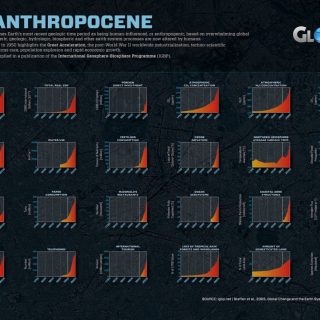
As I’ve discussed in an earlier post, the Anthropocene is a concept coined a little over a decade ago by scientists to describe the massive scale of changes happening to the Earth’s biosphere directly linked to human actions. This past week provided one of the best examples of what the Anthropocene looks like in practice: record breaking warm weather, historically unprecedented catastrophic weather, massive crop disasters from exotic insect threats, and a decade of massive natural disasters all linked to human activity.
Welcome to the Anthropocene, where up is down and down is up, and catastrophe is all around. Read More