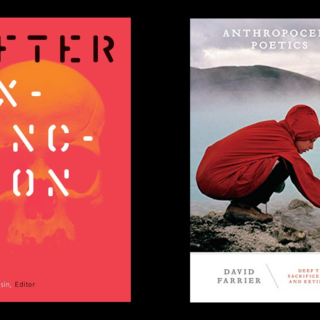
Creationist booksAs I’ve written about before, I had the change to present some of my work on the Anthropocene at the 2013 Western Political Science Association (WPSA) conference in Hollywood recently. For someone writing about this topic, having 3 panels in a row on the subject was great, and gave me lots to think about in terms of not only how I am framing the project, but how others are thinking about this topic as well.

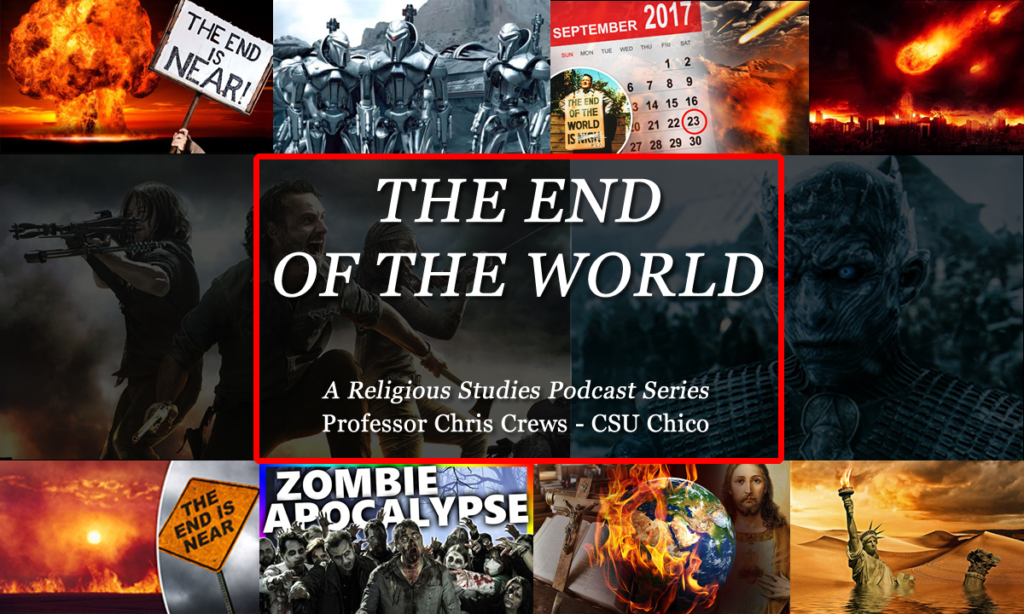
I finally had some time this weekend to put the audio of my talk together with the powerpoint presentation I gave, so now you can experience the whole thing for yourself almost as if you were there in LA. As a bit of context, this talk is based on ongoing research I am doing for my dissertation, which is on the topic of the Anthropocene and its various intersections with environmental politics today. This material in particular is part of the chapter I am writing on the intersection of religious politics and the environment.


The accompanying paper that this talk was derived from can be found here for those interested. To learn more about the Anthropocene, or see more of my writing on it, check out my Anthropocene page on this site. For more on the religion and ecology links, check out the Ecology+Religion page.

Until next time…who’s keeping time!

###

Tags : , , , , , , , , | 1 comment

As I noted recently, there’s some new data out from several sources showing long-term and historical temperature changes, none of which is encouraging, followed closely by the usual climate denial pr machine. I’ve spent a lot of hours over the past week reading various climate denial blogs and surfing their networks, as I’m finalizing a paper I will be presenting on Christian fundamentalism and the Anthropocene for the upcoming WPSA Conference in Hollywood, CA. And as anyone involved in this work knows, it’s becoming increasingly hard to separate the climate denial movement from Christian fundamentalist movement and their Bible-based attacks on all things green, secular or–well, basically even marginally sane. Read More

Tags : , , , , , , , | what do you think, comment now:

This week saw two important notes in climate news and events. First, an AP Wire story on new climate data revealing an alarming but unsurprising trend–more CO2 in the atmosphere.

The amount of heat-trapping carbon dioxide in the air jumped dramatically in 2012, making it very unlikely that global warming can be limited to another 2 degrees as many global leaders have hoped, new federal figures show. Scientists say the rise in CO2 reflects the world’s economy revving up and burning more fossil fuels, especially in China. Carbon dioxide levels jumped by 2.67 parts per million since 2011 to total just under 395 parts per million, says Pieter Tans, who leads the greenhouse gas measurement team for the National Oceanic and Atmospheric Administration. That’s the second highest rise in carbon emissions since record-keeping began in 1959…More coal-burning power plants, especially in the developing world, are the main reason emissions keep going up — even as they have declined in the U.S. and other places, in part through conservation and cleaner energy.

Read More

Tags : , , , , , , , | 1 comment

Anthropocene Updates

Posted by horatio on Saturday Mar 9, 2013 Under Anthropocene, environmental politics, news, political ecology, science

Latest news on the Anthropocene science front: global warming still happening, breaking records yet again. You can read the Dot Earth post by Andrew Revkin here, and the journal Science article here. The short and sweet is that we have a new and seemingly comprehensive data set reconstructing not just part, but the entire, Holocene data temperatures. And guess what, it reinforces and extends the “hockey stick” analogy for climate change.

Read More

Tags : , , , , | 1 comment

Last month I had the chance to write a response piece for the IRCPL, where a friend happens to work, about a public talk given by Wallack Broecker at Columbia. The published piece can be read on the IRCPL website here.

What follows here is an extended version I originally wrote, and decided to publish here, since it has additional multimedia better suited to a post here.

[Updated 12/10]

As a lifelong advocate of environmental education and a student of catastrophic and apocalyptic discourses in popular culture today, I was excited to hear that Columbia University’s Institute for Religion, Culture and Public Life (IRCPL) was bringing Wallace Broecker to talk about climate change and apocalypse as part of their yearlong series Apocalypse Now, which is billed as a “series of conversations with writers that explores our current fascination with apocalyptic visions.” The talk also included NY Times writer John Broder, who covers environmental issues in Washington. Read More

Tags : , , , | what do you think, comment now:

“The danger signs are all around.” UN Secretary-General Ban Ki-Moon

While we really don’t need UN Secretary-General Ban Ki-Moon to tell us how f’d the planet and all of us are, it’s somewhat refreshing hearing a die-hard moderate like Ki-Moon speaking honestly about the coming crisis. Speaking from Doha last week at the annual UN climate talks.

Ki-Moon told members that time is running out, citing a growing number of recent reports that all show rising CO2 levels and other similar worrisome environmental indicators. “The abnormal is the new normal,” Ki-Moon told those at the UN meeting. “This year we have seen Manhattan and Beijing under water, hundreds of thousands of people washed from their homes in Colombia, Peru, the Philippines, Australia.” Read More

Tags : , , , , , , , | what do you think, comment now:

So I am officially ABD as of Friday afternoon. One more hurdle cleared on the long march towards completing my PhD studies here in New York. Having completed my dissertation proposal defense this Friday at The New School for Social Research, it seems like as good a time as any to reflect on what this means, and where I go from here. (Thanks to Sabine for the great abd cartoon.)

So a PhD proposal defense, for those not familiar with it, goes something like this. You send a draft of your proposal (here’s mine) to your committee members–four in my case–and once they feel it is ready to defend, you set an oral defense date. The committee then gets together on a set date and discusses your paper for about 15-30 min, then calls you in. You then have about 10 minutes to describe the larger thrust of your project. I also included a large visual map to supplement my presentation, which was taped to the wall. Following that is a question and answer grilling, in which your proposal gets dissected and recombined, hopefully into something that both you and your committee feel makes sense. Then they ask you to leave and discuss amongst themselves if the proposal seems solid enough to approve with some modifications based on the previous discussion. Then you are called back into the room and read the verdict, which in my case was approved. A short discussion followed, and the defense concluded. All told it took just under 2.5 hours. Read More

Tags : , , , | what do you think, comment now:

Come hell or high water tomorrow, which in New York these days it’s hard to know which is more likely, my PhD dissertation proposal defense will be over. I’m expecting it to be successful. However, I was not able to use some of the multimedia and visuals I had hoped to be able to use in the defense itself. But that wouldn’t stop me. If technology is the problem, so be it. And so I went back to old school-ish methods–the printed, large-format visual bricolage. Viola! So in all its glory, here is my attempt to compress some of my project, which is looking at the intersections of religion, science, popular culture and environmental politics in the Anthropocene, into one large visual map. Apologies if some of the smaller sections are harder to read. The full original is 72″ x 48″.

If you want to read more about the project, check out my proposal here. If you’re wondering what the Anthropocene is, check out some of my older posts here.

Until next time…banzai!

###

Tags : , , , , , , , , , , , | 1 comment

{Revised 11/4} *Added more discussion on the energy policy-natural disasters link – thanks to BL-T.

Roger Pielke recently wrote a piece in the WSJ called ‘Hurricanes and Human Choice’ that discussed the relationship between increasing natural disaster impacts and human settlement and lifestyle choices. In that piece he argued against considering Hurricane Sandy as some sort of “new normal” event, a claim which I explored and largely supported in my last post here. Two points made by Pielke are worth meditating on: Read More

Tags : , , , , | 1 comment

Now that we’re almost a week past Hurricane Sandy having made landfall along the East Coast, and slamming us here in New York, we’re finally starting to get a picture of the full extent of the damages, and perhaps more importantly, a sense of just how unprepared we were for a natural event of this magnitude. It’s clear from reviewing the evidence that New York is not, and perhaps will never be, prepared to deal with a storm of this magnitude. That’s bad news for a major metropolitan coastal city, and with all projections around climate change related weather showing trends of bigger, badder and more frequent storms likely in the future, Hurricane Sandy may be an omen of things to come in this new Anthropocene world. Read More

Tags : , , , , , , , , , , , , | 1 comment